

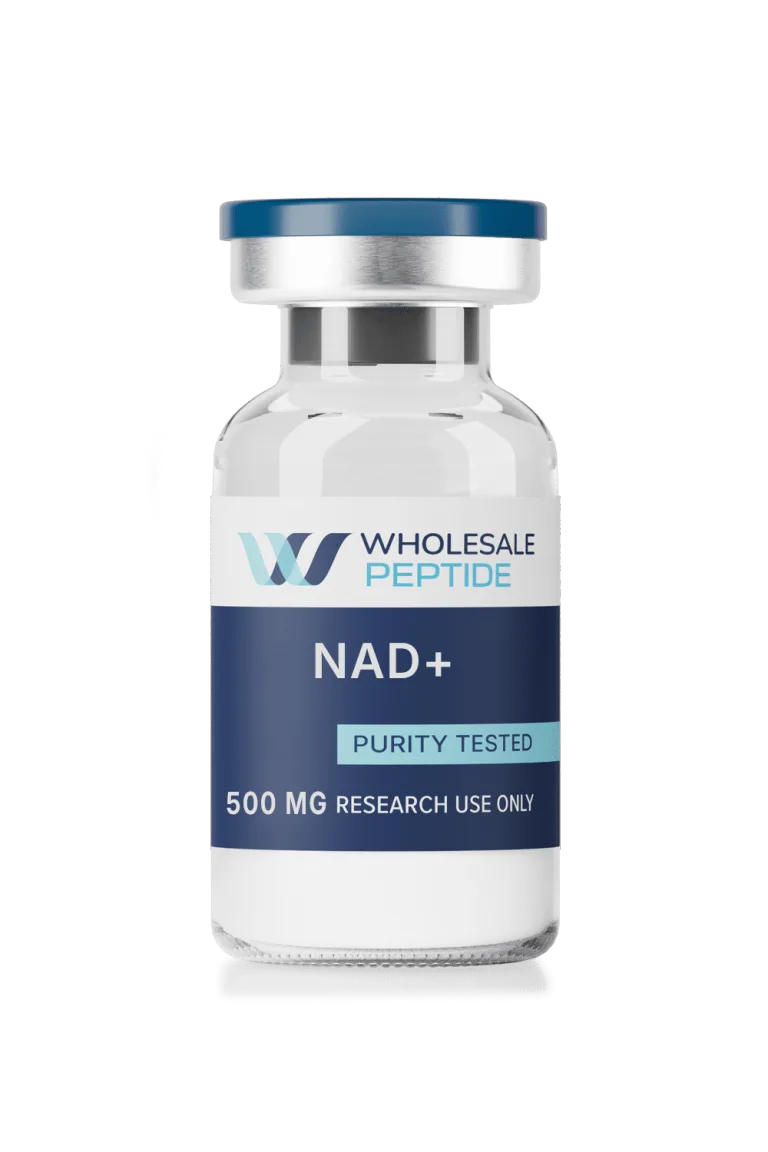

NAD+ Wholesale
Research-Grade Bulk Supply
Nicotinamide Adenine Dinucleotide — the coenzyme at the center of cellular energy production, DNA repair, and sirtuin-mediated longevity research. NAD+ levels decline ~50% between age 20 and 50, making it the most studied coenzyme in aging biology. Research-grade ≥98% purity, full COA every batch, cold-chain shipping. High-value SKU for IV clinics, longevity practices, and research institutions.
What Is NAD+? The Central Coenzyme of Longevity Research
NAD+ (Nicotinamide Adenine Dinucleotide) is not a peptide — it is an essential coenzyme present in every living cell, required for life itself. It serves as the primary electron carrier in the mitochondrial electron transport chain, shuttling electrons from metabolic substrates to ATP synthase in the process of oxidative phosphorylation. Without NAD+, cellular energy production stops.
Beyond bioenergetics, NAD+ is the substrate for three families of critical regulatory enzymes: sirtuins (SIRT1–7), which are NAD+-dependent deacetylases regulating gene expression, metabolism, and stress resistance; PARP enzymes (poly ADP-ribose polymerases), which consume NAD+ during DNA repair; and CD38/CD157, which mediate immune signaling and calcium homeostasis via ADP-ribosylation. The competition between these enzyme families for a finite NAD+ pool — particularly PARP enzymes during oxidative stress — is a central mechanism in aging biology research.
The research significance of NAD+ wholesale supply in 2026 is driven by one critical finding replicated across multiple published studies: NAD+ levels decline approximately 50% between age 20 and 50 in human tissue. This measured, age-dependent decline in cellular NAD+ availability — documented across skeletal muscle, brain, liver, and blood samples — is directly correlated with reduced mitochondrial function, impaired DNA repair, altered sirtuin activity, and age-associated metabolic changes. This data is the scientific foundation for the entire NAD+ longevity research market.
Cellular Energy Production
NAD+ is the primary electron carrier in the mitochondrial electron transport chain. NADH (reduced NAD+) donates electrons to Complex I, driving the proton gradient that powers ATP synthase. Every calorie of metabolic energy processed by aerobic cells passes through the NAD+/NADH redox cycle.
Sirtuin Activation
Sirtuins (SIRT1–7) are NAD+-dependent protein deacetylases and ADP-ribosyltransferases. Each sirtuin catalytic cycle consumes one NAD+ molecule. SIRT1 and SIRT3 regulate mitochondrial biogenesis via PGC-1α; SIRT6 regulates DNA repair and telomere maintenance; SIRT5 regulates mitochondrial metabolism. Low NAD+ = impaired sirtuin activity = accelerated aging phenotypes.
DNA Repair via PARP
PARP enzymes (PARP1, PARP2) detect DNA strand breaks and rapidly consume NAD+ to synthesize poly-ADP-ribose chains that signal repair machinery. Oxidative stress-driven DNA damage triggers massive PARP activation that can deplete cellular NAD+ pools — creating a feedforward cycle of NAD+ depletion and impaired repair capacity studied extensively in aging models.
CD38 & Immune Signaling
CD38 is an ectoenzyme that converts NAD+ to cyclic ADP-ribose (cADPR) and ADPR, regulating intracellular calcium signaling critical for immune cell activation and insulin secretion. CD38 expression increases with age and inflammation, becoming a major NAD+-consuming pathway in aged tissues — a mechanism studied in immune aging and metabolic research contexts.
NAD+ as a Substrate — The Four Enzyme Families
NAD+ is unique among coenzymes in that it is both an electron carrier (NAD+/NADH redox cycling) and a signaling substrate consumed by regulatory enzyme families. Understanding the four primary NAD+-consuming pathways is essential for designing NAD+ research protocols and understanding the biology underlying NAD+ supplementation research.
Oxidoreductases — Redox Cycling
NAD+ accepts hydride from metabolic substrates (glucose, fatty acids, amino acids), becoming NADH. NADH is re-oxidized to NAD+ in the electron transport chain, regenerating the NAD+ pool. This cycle is the engine of aerobic energy metabolism.
Sirtuins (SIRT1–7) — Deacetylases
Each catalytic cycle consumes 1 NAD+ per deacetylation event, producing nicotinamide (a feedback inhibitor) and O-acetyl-ADP-ribose. Seven sirtuin isoforms regulate metabolism, stress resistance, DNA repair, and mitochondrial function.
PARPs — DNA Repair
PARP1 consumes up to 200 NAD+ molecules per activation event during DNA repair, synthesizing poly-ADP-ribose chains. Under heavy genotoxic stress, PARP activation can deplete cellular NAD+ within minutes.
CD38 / CD157 — Calcium Signaling
CD38 has very low catalytic efficiency — it consumes ~100 NAD+ molecules to produce 1 cADPR. Despite this inefficiency, CD38 is the dominant NAD+-consuming enzyme in aged tissue due to its dramatically increased expression with aging and inflammation.
NAD+ vs NMN vs NR — Which to Wholesale
NAD+, NMN, and NR are the three primary NAD+-related compounds in wholesale research supply. They are not interchangeable — each has a distinct molecular role, research application context, and wholesale buyer profile.
| Property | NAD+ | NMN | NR |
|---|---|---|---|
| Type | Active coenzyme | NAD+ precursor | NAD+ precursor |
| Molecular Weight | 663.43 Da | 334.22 Da | 255.25 Da |
| CAS Number | 53-84-9 | 1094-61-7 | 1341-23-7 |
| Requires conversion to act | No — direct coenzyme | Yes → NAD+ | Yes → NMN → NAD+ |
| Direct sirtuin substrate | ✓ Yes | ✗ No | ✗ No |
| IV infusion research use | ✓ Primary compound | ✗ Not standard | ✗ Not standard |
| In vitro cell culture use | ✓ Standard | ✓ With caveats | Limited |
| Oral bioavailability research | Limited (degraded in GI) | ✓ Higher bioavailability | ✓ Oral absorption established |
| Primary wholesale buyer | IV clinics, research labs | Longevity supplement brands | Oral supplement manufacturers |
For wholesale buyers supplying IV infusion clinics, research laboratories, or direct NAD+ biology research programs, NAD+ is the correct compound — it is the active coenzyme itself, not a precursor requiring conversion. NMN and NR are the compounds of choice for oral supplement formulation — a different market segment. We stock all three; contact our B2B desk for NMN and NR wholesale pricing.
NAD+ Wholesale — Full Specifications
Chemical & Molecular Data
| Full Name | Nicotinamide Adenine Dinucleotide (oxidized) |
| Abbreviation | NAD+ / NAD |
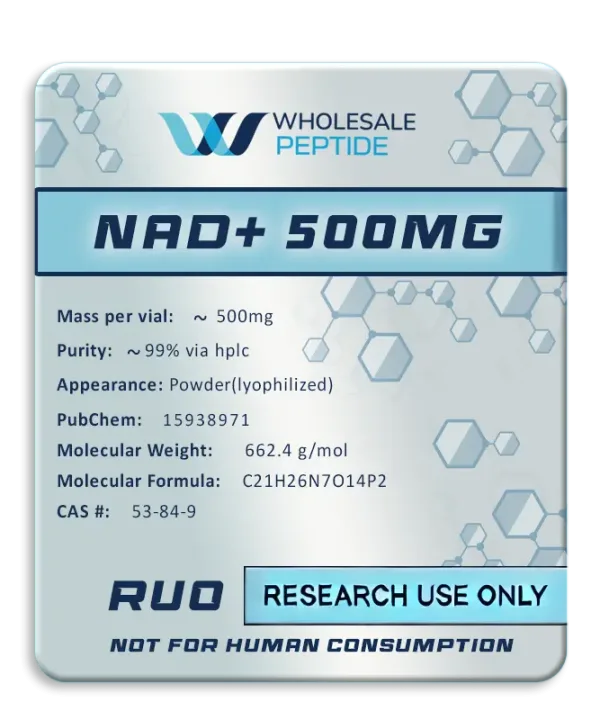
| Molecular Weight | 663.43 Da |
| Molecular Formula | C₂₁H₂₇N₇O₁₄P₂ |
| CAS Number | 53-84-9 |
| Physical Form | Lyophilized white powder |
| Solubility | Water, saline, sterile water (freely soluble) |
| Photosensitivity | Yes — amber vials required |
Quality & Purity Standards
| Purity | ≥98% (HPLC verified) |
| Identity | Mass spectrometry (MW 663.43 Da) |
| Endotoxin | <1 EU/mg (LAL method) |
| Water Content | <5% (Karl Fischer) |
| Residual Solvents | ICH Q3C compliant |
| Storage (lyophilized) | -20°C · amber vials · 24+ months |
| Post-reconstitution | 4°C · use within 24–48 hours |
| Solution stability note | NAD+ in solution is less stable than most peptides — reconstitute only what is needed |
NAD+ Wholesale Price — Volume Tiers 2026
NAD+ is a high-value SKU in the longevity and research wholesale catalog — at $102–$120 per 500mg vial, it commands the highest per-vial price of the core peptide catalog, reflecting its molecular complexity and synthesis demands. Volume pricing rewards consistent buyers.
| Quantity | Total Price | Per Vial | Per mg | Availability |
|---|---|---|---|---|
| NAD+ 500mg × 1 | $102 | $102 | $0.204 / mg | ✓ In Stock |
| NAD+ 500mg × 10CLINIC PACK | $950 | $95 | $0.190 / mg | ✓ In Stock |
| NAD+ 500mg × 25 | $2,200 | $88 | $0.176 / mg | ✓ In Stock |
| NAD+ 500mg × 50 | $4,000 | $80 | $0.160 / mg | ✓ In Stock |
| NAD+ 500mg × 100+ | Contact | Custom | Custom rate | ✓ In Stock |
NAD+ in Peer-Reviewed Research — Key Study Areas 2026
NAD+ has one of the most extensive research bases of any compound in the longevity and aging biology space, with thousands of publications spanning cellular bioenergetics, aging mechanisms, neurological function, and metabolic health.
NAD+ Decline & Aging — The Core Research Finding
Multiple published studies have documented age-associated NAD+ decline across human and animal tissues. Zhu et al. (2015, Cell Metabolism) demonstrated a 50%+ decline in skeletal muscle NAD+ from young to old mice, with parallel findings in human studies. Massudi et al. (2012, PLOS ONE) documented declining NAD+ in human blood across age groups. These quantified declines in NAD+ are the biological foundation for NAD+ longevity research and the primary driver of the $577M+ global NAD+ research market.
Published in Cell Metabolism, PLOS ONE, Nature Metabolism, and related journals
Sirtuin Biology & Longevity Research
The SIRT1/PGC-1α axis — in which NAD+-dependent SIRT1 deacetylates and activates PGC-1α to drive mitochondrial biogenesis — is one of the most studied mechanisms in aging biology. Guarente Lab (MIT) and Sinclair Lab (Harvard) have each published extensively on sirtuin-mediated longevity pathways requiring NAD+ availability. SIRT6’s role in telomere maintenance and DNA repair has been demonstrated in multiple published model systems.
Published in Science, Cell, Nature, Nature Metabolism; Guarente and Sinclair laboratory publications
Neurological Research — Neuroprotection & Cognitive Function
NAD+ research in neurological contexts covers Alzheimer’s disease models (NAD+ depletion correlates with amyloid pathology in published studies), Parkinson’s disease mitochondrial dysfunction models, traumatic brain injury neuroprotection research, and cognitive function studies. NAMPT (the rate-limiting enzyme in the NAD+ salvage pathway) expression in brain tissue and its role in synaptic plasticity is an active research area in 2026.
Published in Nature Neuroscience, Journal of Alzheimer’s Disease, Cell Reports, 2020–2025
IV NAD+ Infusion Research
Intravenous NAD+ administration bypasses intestinal NAD+ degradation (which limits oral bioavailability) and rapidly elevates plasma and tissue NAD+ levels. Published pharmacokinetic studies have characterized IV NAD+ absorption profiles, tissue distribution, and duration of effect. IV NAD+ infusion protocols have generated significant research interest in addiction medicine, neurology, and longevity medicine — driving substantial clinic-level wholesale demand for research-grade NAD+ in 2026.
Multiple clinical and pharmacokinetic publications; active research in addiction medicine, neurology, and longevity medicine
NAD+ Wholesale Quality Standards
NAD+ quality verification requires attention to two factors beyond standard HPLC purity: oxidation state verification (NAD+ must be in the oxidized form — NADH contamination reduces bioactivity) and photostability (NAD+ degrades on UV exposure). Our COA confirms both.
Full COA Per Lot
Every batch ships with COA. HPLC purity ≥98%, mass spec identity. Available pre-purchase.
Oxidation State
NAD+ verified in oxidized form (not NADH). Oxidation state confirmed by UV absorbance profile on COA.
Amber Vials
All NAD+ shipped in amber glass vials. UV-protective cold-chain packaging standard — photosensitivity managed from production to delivery.
Endotoxin Tested
LAL endotoxin <1 EU/mg confirmed on every batch COA.
Cold-Chain
Ships cold-chain. -20°C stable 24+ months. Reconstituted solution: use within 24–48 hours at 4°C.
48h Fulfillment
In-stock orders ship within 48 business hours with cold-chain manifest and tracking.
Who Buys NAD+ Wholesale
NAD+’s dual role as a research compound and IV clinic supply compound gives it a broad institutional buyer base. Not available to the general public.
IV Infusion Clinics
The highest-volume wholesale buyer category. IV NAD+ infusion protocols require consistent, high-purity supply — NAD+ is the highest per-vial revenue SKU in IV clinic peptide supply.
Longevity & Anti-Aging Practices
Longevity medicine programs incorporating NAD+ infusion or injection protocols alongside GH secretagogue and metabolic research programs.
Research Institutions & CROs
Academic labs and CROs with active NAD+ biology, sirtuin, PARP, aging, mitochondrial, or neurological research programs.
Addiction Medicine Clinics
Clinics running IV NAD+ infusion research protocols in addiction recovery and neurological rehabilitation contexts.
Regenerative Medicine Practices
Practices running NAD+ alongside peptide stacks as part of comprehensive cellular regeneration and metabolic restoration research programs.
Compounding Pharmacies
503A/503B pharmacies requiring research-grade NAD+ for injectable formulation programs and documented clinical research supply chains.
NAD+ Wholesale — Frequently Asked Questions
Research Use Only: NAD+ and all products on this page are sold strictly for in vitro research, laboratory, and research-grade compounding use only. Not intended for human or veterinary consumption except as part of a licensed research or medical protocol by qualified professionals. Not an FDA-approved drug or dietary supplement when sold as a research chemical. No claims are made regarding therapeutic efficacy in humans. Buyers are solely responsible for compliance with all applicable federal, state, and local laws. By purchasing, you confirm you are a licensed researcher, qualified medical professional, or institutional buyer acting within the scope of a legitimate research or clinical program.
Reviews
There are no reviews yet.