


BPC-157 Wholesale
Research-Grade Bulk Supply
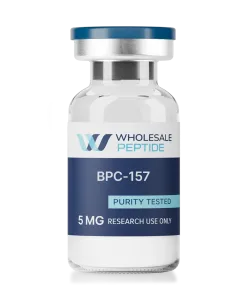
The most searched healing and recovery peptide in 2026. BPC-157 (Body Protection Compound 157) is a synthetic 15-amino-acid gastric pentadecapeptide with an extensive preclinical research base spanning tendon repair, gut healing, angiogenesis, and neurological models. HPLC-verified ≥98% purity, full COA every batch, cold-chain shipping.
What Is BPC-157? The Body Protection Compound Explained
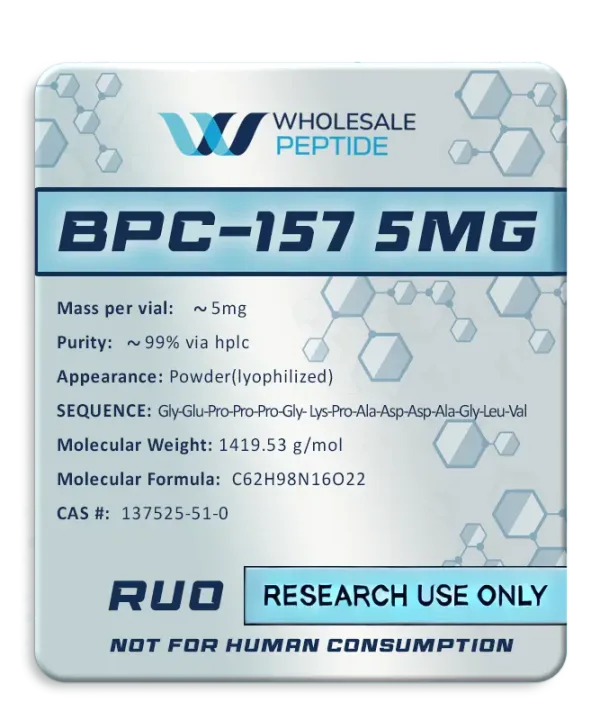
BPC-157 (Body Protection Compound 157) is a synthetic pentadecapeptide — a chain of 15 amino acids — derived from a naturally occurring protein sequence found in human gastric juice. Its full sequence is: Gly-Glu-Pro-Pro-Pro-Gly-Lys-Pro-Ala-Asp-Asp-Ala-Gly-Leu-Val. First characterized by researchers at the University of Zagreb in the 1990s, BPC-157 has accumulated one of the largest bodies of preclinical research of any synthetic peptide, with hundreds of peer-reviewed publications across multiple tissue systems and animal models.
The peptide is highly stable in the acidic gastric environment — remaining intact for more than 24 hours — which distinguishes it from most peptides that degrade rapidly in acidic conditions. This stability is the basis for both its biological origin context (gastric juice) and its versatility in research administration models. For wholesale buyers, BPC-157 is supplied as a research-grade lyophilized powder in hermetically sealed 5mg vials, HPLC-verified at ≥98% purity with full COA including endotoxin testing and TFA content — two quality markers frequently omitted by lower-quality wholesale suppliers.
BPC-157 generates over 165,000 monthly searches for wholesale and research-grade supply, making it the undisputed #1 non-GLP-1 peptide by search volume in 2026. Its high repeat-purchase rate — driven by consistent institutional demand from sports medicine practices, physical therapy research programs, and regenerative medicine clinics — makes it one of the most reliable B2B SKUs in the peptide wholesale category.
Gastric Pentadecapeptide
BPC-157 is derived from a protein naturally present in human gastric juice and is exceptionally stable in acidic environments. Its 15-amino-acid sequence is well-characterized and synthetic production is highly reproducible — meaning quality verification is achievable and any reputable wholesale supplier should have no excuse for skipping third-party testing.
Multi-Pathway Signaling
BPC-157 interacts with multiple receptor signaling systems simultaneously — VEGFR2, PDGFR, FAK-paxillin, nitric oxide pathways, and growth hormone receptor signaling. This multi-pathway activity is why BPC-157 research spans such a wide range of tissue types and system models, from musculoskeletal to gastrointestinal to neurological.
#1 Non-GLP-1 By Volume
165,000+ monthly searches make BPC-157 the most searched healing peptide globally and #1 non-GLP-1 research peptide in 2026. Institutional repeat-purchase rates from sports medicine, physical therapy research, and regenerative medicine programs provide consistent, predictable B2B demand that outlasts trend cycles.
FDA Category 2 Status
In 2024, the FDA moved BPC-157 to the 503A Category 2 bulks list, restricting its use in compounding pharmacies. This regulatory change concentrated BPC-157 wholesale demand into licensed research channels — making supply documentation, COA quality, and supplier credibility more critical than ever for institutional buyers.
BPC-157 Signaling Pathways — How It Works at the Molecular Level
BPC-157’s broad preclinical research profile stems from its ability to engage multiple signaling pathways across different tissue systems. Understanding these pathways is essential for designing research protocols and for differentiating BPC-157 from other healing peptides like TB-500.
VEGFR2 & Angiogenesis
BPC-157 activates VEGFR2 (vascular endothelial growth factor receptor 2) via internalization and outside-in signaling, promoting new blood vessel formation (angiogenesis) to injured tissues. This is the primary mechanism studied in tendon and muscle repair models.
FAK-Paxillin Pathway
Activation of the FAK (focal adhesion kinase)-paxillin pathway promotes cell migration, fibroblast recruitment, and tissue remodeling. Published research has demonstrated enhanced fibroblast outgrowth from tendon explants in vitro at low nanomolar concentrations.
Nitric Oxide (NO) Modulation
BPC-157 modulates nitric oxide production via the Akt-eNOS pathway, improving blood flow to injured areas and reducing endothelial dysfunction. This pathway has been studied in gut, vascular, and musculoskeletal injury models.
Growth Factor Receptor Signaling
BPC-157 interacts with PDGFR (platelet-derived growth factor receptor) and growth hormone receptor signaling pathways, amplifying the tissue-repair signaling cascade across multiple cell types including fibroblasts, smooth muscle cells, and endothelial cells.
Anti-Inflammatory Activity
BPC-157 has been shown in preclinical models to reduce pro-inflammatory cytokine expression including TNF-α and IL-6, supporting its research use in models of tissue inflammation, gut permeability disruption, and NSAID-induced gastropathy.
Neurological Pathway Activity
BPC-157 has demonstrated activity in dopaminergic and serotonergic pathway models in preclinical research. Published studies have examined its role in nerve regeneration, neurotoxicity models, and CNS injury recovery — expanding its research relevance beyond musculoskeletal applications.
BPC-157 Wholesale — Full Specifications
Every BPC-157 vial meets or exceeds the following specifications. COA documentation available for every lot number prior to purchase.
Chemical & Molecular Data
| Common Name | BPC-157 (Body Protection Compound) |
| Also Known As | Gastric pentadecapeptide BPC 157 |
| Sequence Length | 15 amino acids |
| Molecular Weight | 1,419.53 Da |
| Molecular Formula | C₆₂H₉₈N₁₆O₂₂ |
| CAS Number | 137525-51-0 |
| Physical Form | Lyophilized white powder |
| Solubility | Bacteriostatic water, sterile water, acetic acid solution |
Quality & Purity Standards
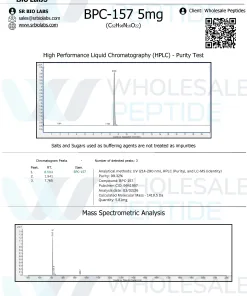
| HPLC Purity | ≥98% (batch tested) |
| Identity | Mass spectrometry confirmed |
| Endotoxin | <1 EU/mg (LAL method) |
| Sterility | Sterile-filtered, aseptic fill |
| TFA Content | Tested & reported on COA |
| Water Content | <5% (Karl Fischer) |
| Storage (lyophilized) | -20°C · 24+ months |
| Post-reconstitution | 4°C · use within 28 days |
BPC-157 Wholesale Price — Volume Tiers 2026
BPC-157’s synthesis is well-characterized and highly reproducible, making it one of the most competitively priced research peptides per milligram. Volume tiers reward clinic-scale buyers with significant per-unit savings.
| Quantity | Price | Per Vial | Per mg | Availability |
|---|---|---|---|---|
| BPC-157 5mg × 1 | $33 | $33 | $6.60 / mg | ✓ In Stock |
| BPC-157 5mg × 10CLINIC PACK | $290 | $29 | $5.80 / mg | ✓ In Stock |
| BPC-157 5mg × 25 | $680 | $27.20 | $5.44 / mg | ✓ In Stock |
| BPC-157 5mg × 50 | $1,250 | $25.00 | $5.00 / mg | ✓ In Stock |
| BPC-157 5mg × 100+ | Contact | Custom | Custom rate | ✓ In Stock |
BPC-157 vs TB-500 Wholesale — Differences & Research Stack
BPC-157 and TB-500 are the two most frequently co-purchased healing peptides in wholesale research supply. Understanding their distinct mechanisms explains why they are commonly stacked together rather than used interchangeably.
| Property | BPC-157 | TB-500 |
|---|---|---|
| Full Name | Body Protection Compound 157 | Thymosin Beta-4 Fragment (Ac-SDKP) |
| Amino Acids | 15 amino acids | 43 amino acids |
| Molecular Weight | 1,419.53 Da | 4,963.44 Da |
| Primary Mechanism | VEGFR2, FAK-paxillin, NO, PDGFR | Actin sequestration, cell migration |
| Action Profile | Tissue-local + systemic | Primarily systemic |
| Gut Research | ✓ Extensive preclinical data | Limited |
| Tendon Research | ✓ Extensive preclinical data | ✓ Strong preclinical data |
| Neural Research | ✓ Dopaminergic, serotonergic models | Limited |
| Angiogenesis | ✓ VEGFR2-mediated | ✓ Actin-mediated endothelial migration |
| Gastric Stability | ✓ Stable >24h in acid | Degrades rapidly |
| Common Stack Use | BPC-157 + TB-500 Blend | BPC-157 + TB-500 Blend |
The BPC-157 + TB-500 combination stack is the most popular healing peptide pairing in wholesale research supply. BPC-157 provides local tissue repair signaling and gut-protective effects; TB-500 provides systemic cell migration and actin-based repair amplification. Also available as a pre-made blend — see our BPC-157 / TB-500 Blend Wholesale listing.
BPC-157 in Peer-Reviewed Research — Key Study Areas
BPC-157 has one of the largest preclinical research databases of any synthetic peptide, with hundreds of publications spanning over three decades. The following summarizes the dominant research areas. All references pertain to published preclinical studies — as of 2026, human clinical trial data remains limited.
Musculoskeletal Repair — Tendon, Ligament & Muscle
Rat Achilles transection studies consistently demonstrate accelerated tendon healing with BPC-157 treatment, with load-to-failure recovery reported 30–50% faster versus saline controls in published animal models. Fibroblast outgrowth from tendon explants is enhanced in vitro at low nanomolar concentrations. The mechanism appears mediated by VEGFR2 internalization and the Akt-eNOS signaling cascade. Muscle-to-bone reattachment models (quadriceps detachment) have shown structural and functional recovery in treated groups not observed in controls.
Extensive publication record in Journal of Orthopaedic Research, Knee Surgery Sports Traumatology Arthroscopy, and related journals
Gastrointestinal & Gut Permeability Research
BPC-157’s origin in gastric juice provides the foundation for its extensive GI research profile. Published studies cover stomach lining protection, gut permeability restoration, inflammatory bowel disease models, NSAID-induced gastropathy reversal, and gut-brain axis interactions. The peptide’s gastric acid stability (24+ hours) distinguishes it from most orally administered peptides and has driven oral administration model research.
Published in Journal of Physiology and Pharmacology, Current Pharmaceutical Design, and related GI journals
Neurological & CNS Research
Preclinical research has explored BPC-157 in dopaminergic system models (MPTP neurotoxicity), serotonergic pathway studies, spinal cord injury models, and peripheral nerve regeneration. The peptide’s interaction with the growth hormone receptor signaling pathway has positioned it in research examining CNS recovery and neuroprotection — making it relevant for neurological research programs beyond its more widely known musculoskeletal applications.
Publications in Neuroscience Letters, Brain Research, and related neuroscience journals
Vascular & Wound Healing Research
BPC-157’s angiogenic activity via VEGFR2 and NO modulation has been studied extensively in vascular repair, wound closure, and skin healing models. Published research demonstrates accelerated wound healing timelines, improved blood vessel density at injury sites, and enhanced tissue oxygenation — making BPC-157 relevant to dermatological, surgical, and vascular research programs.
Published in Wound Repair and Regeneration, Journal of Vascular Surgery, and related journals
BPC-157 Wholesale Quality Standards
BPC-157 synthesis is well-characterized and reproducible — which means there is no excuse for any legitimate wholesale supplier to skip third-party testing. The key quality markers that separate research-grade from substandard wholesale BPC-157 supply are HPLC purity, mass spectrometry identity, endotoxin level, and TFA (trifluoroacetic acid) content — a synthesis byproduct that should be measured and reported, not ignored.
Full COA Per Lot
Every batch ships with a COA. Lot numbers match vials. Available pre-purchase.
HPLC + Mass Spec
Purity ≥98% by HPLC. MW 1,419.53 Da confirmed by mass spectrometry.
Endotoxin & Sterility
LAL endotoxin <1 EU/mg. Sterile-filtered, aseptic fill confirmed.
TFA Content Reported
TFA content tested and disclosed on COA — a marker most cut-rate suppliers omit.
Cold-Chain Shipping
Lyophilized vials ship cold-chain. Stable at -20°C for 24+ months.
48h Fulfillment
In-stock orders ship within 48 business hours with tracking and cold-chain manifest.
Who Buys BPC-157 Wholesale
BPC-157’s high repeat-purchase rate reflects its consistent demand across multiple institutional buyer categories. Not available to the general public.
Sports Medicine Practices
High-volume repeat buyers. Musculoskeletal research application drives consistent monthly ordering cycles for clinics with active recovery research programs.
Physical Therapy Research Programs
PT research centers studying tissue repair, rehabilitation protocols, and recovery optimization consistently include BPC-157 in their wholesale peptide supply.
Regenerative Medicine Clinics
Regenerative and integrative medicine practices running tissue repair and recovery research protocols under physician oversight.
Research Institutions & CROs
Universities and contract research organizations with active musculoskeletal, GI, neurological, or vascular preclinical research programs.
Longevity & Anti-Aging Practices
Longevity-focused medical practices incorporating healing and recovery peptide protocols alongside metabolic and hormonal research programs.
Peptide Distributors
B2B wholesale distributors supplying downstream licensed research buyers. BPC-157’s consistent demand makes it a reliable base SKU for any peptide wholesale catalog.
BPC-157 Wholesale — Frequently Asked Questions
Research Use Only: All products listed on this page, including BPC-157, are sold strictly for in vitro research, laboratory use only. These products are not intended for human or veterinary use, consumption, injection, or any therapeutic application. They are not FDA-approved drugs or dietary supplements. BPC-157 was moved to the FDA 503A Category 2 bulks list in 2024 and is not available for compounding pharmacy use. No claims are made regarding safety, efficacy, or therapeutic benefit in humans or animals. Buyers are solely responsible for compliance with all applicable federal, state, and local laws. By purchasing, you confirm you are a licensed researcher or qualified institutional buyer acting within the scope of a legitimate research program.
Reviews
There are no reviews yet.